The death of Fanny Robin and her child
Far from the Madding CrowdThe death of Fanny Robin and her child is the revelation that transforms a poor woman’s isolated death into a devastating exposure of Sergeant Troy’s unresolved past. Fanny dies in the Casterbridge Union-house after walking there from Melchester, and her unborn child dies with her. When Bathsheba learns that Fanny passed near Weatherbury shortly before reaching the Union, her questions and sudden physical distress betray the connection she fears; Gabriel Oak, recognizing what the coffin’s inscription will disclose, erases the words “and child” before leaving the house.
Death in the Union-house
Fanny had been living by sewing in Melchester, at the home of a widow who took in such work. She arrived at the Union-house early on Sunday morning, apparently having walked the whole way from Melchester, and died later that day. Joseph Poorgrass reports that she had been there only a day or two, not a settled inmate. Her death is attributed tentatively to general weakness and hardship: he describes her as feeble and worn out, while Gabriel’s account gives the stark sequence of her arrival and death without asserting a precise cause.
The news reaches Bathsheba through Joseph, who has learned it from Gabriel and Boldwood. Fanny’s body is to be brought back to Weatherbury for burial, with four men from the Union meeting the conveyance at the churchyard gate to carry out the burial under the Guardians’ arrangements. Bathsheba refuses to leave the responsibility to Boldwood: Fanny had served her uncle, and, though Bathsheba knew her only briefly, she says Fanny belongs to her. Her first response is practical and compassionate. She orders a clean blue-bodied, red-wheeled spring waggon, flowers and evergreens for the coffin, and Pleasant, the horse Fanny knew, to draw it.
Bathsheba recognizes the implication
As Joseph recounts Fanny’s last journey, Bathsheba learns that Fanny had previously gone to a garrison town and then supported herself by sewing in Melchester. She asks when Fanny passed Weatherbury and whether she took the turnpike road; Joseph believes it was on Saturday night. Bathsheba’s expression changes abruptly, and she grows pale and faint. She presses Joseph about the colour of Fanny’s hair, then turns away, distressed. The questions make her suspicion legible without yet stating it: Fanny may have been travelling to find Troy, Bathsheba’s husband.
Bathsheba’s response to the news is complicated by her own troubled marriage. The previous morning, Troy had left for Casterbridge with the gig and Poppet, while Bathsheba continued to oversee the farm and increasingly relied on Gabriel’s forethought. She had begun to feel a genuine, sisterly friendship for Gabriel, though Troy’s neglect sometimes prompted brief thoughts of what life with Gabriel—or Boldwood—might have been. Against that domestic unease, Fanny’s death and the report of her passage near Weatherbury bring an obscure fear into immediate focus. Bathsheba asks why Gabriel did not tell her himself; Joseph says that Gabriel and Boldwood both seemed deeply troubled.
The body brought into the house
When the waggon arrives, Bathsheba is still visibly disturbed. Joseph can confirm only what Gabriel and Boldwood told him: Fanny reached the Union on Sunday morning and died that afternoon. He repeats that she had walked from Melchester and passed near Weatherbury in the dusk on Saturday, but denies knowing any different story. Bathsheba’s insistence on whether he is sure, and her close scrutiny of him, show how urgently she is trying to establish what remains unspoken.
Bathsheba at first agrees that Fanny’s body should go straight to the church, but changes her mind and asks that it be brought into the house. Gabriel argues that the coffin, already surrounded by flowers and greenery, could remain in the waggon until morning; Bathsheba calls it unkind and unchristian to leave Fanny in a coach-house overnight. The parson agrees to arrange an early funeral, describing Fanny as a fellow-creature and a sister despite her grievous error in leaving home. With Gabriel and three other men assisting, the coffin is carried into a small sitting-room beside the hall and placed on two benches.
The concealed words on the coffin
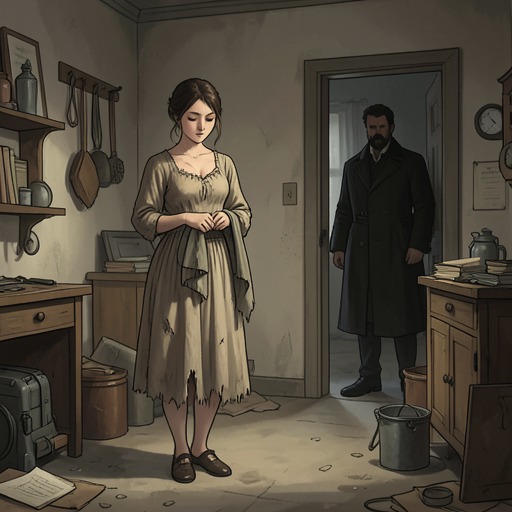
After the others leave, Gabriel remains beside the coffin. He understands the cruel irony: the dead woman is Troy’s wife, and the burial threatens to reveal a truth that could cast a lasting shadow over Bathsheba’s life. On the lid, the chalk inscription reads, “Fanny Robin and child.” Gabriel carefully rubs away the final two words, leaving only Fanny’s name visible, then slips out quietly through the front door.
The act does not undo the fact of Fanny’s pregnancy or remove the consequences of her death. It delays the discovery at a moment when Bathsheba is already shaken by the evidence of Fanny’s journey and by the possibility that Troy is implicated. The scene’s decisive turn lies in the contrast between Bathsheba’s public care for an old servant—flowers, a familiar horse, shelter in the house—and the private truth Gabriel tries to conceal. A respectful funeral becomes the threshold of revelation: Fanny’s death brings her connection to Troy, and the child she carried, into the household that had tried to leave her past behind.